
A report on the state of the art on water clusters, clustering and declustering
the state of knowledge as of 2014.02.10
prepared by: Dr. Marek Doskocz - Research and Development Department of STOMADENT
Water is one of the basic liquids in which life can exist and which is part of living organisms (approx. 60%). Water has unusual physical and chemical properties. among others, such as:
- maximum density at 4oC - it is also one of the few substances that have maximum density in the liquid state,
- high dielectric permeability, which favors the tendency to interact with the electric field,
- high ability to dissolve various chemical compounds. Water is an almost ideal solvent in which, moreover, biochemical reactions can take place,
- in water there are hydrogen bonds, the lack of which would lower the boiling point of water down to about -90oC. Hydrogen bonds are therefore one of the basic elements of the structure of water in water, determining the manner of interaction,
The structure of the water
The spatial structure of water, as a result of still imperfect theoretical knowledge, is sometimes controversial, but as prof. Joanna Sadlej from the National Medicines Institute, “it is the hydrogen bonding network in water that is responsible for many of its anomalous features. All the experimental research to date shows that this is true. But you still need to have evidence for that, which means - you need to know the dynamics of the system and its structure on the femtosecond scale. " (Przegląd Medyczny ... 2011) i It turns out, among others, that in an aqueous solution a water molecule does not behave in the same way as in the hexagonal structure of ice (interaction with 4 molecules through 4 strong hydrogen bonds), but it interacts by creating two strong hydrogen bonds, which makes it possible to build structures of chains or rings (Science 2004) ii, another work (ChemPhysLetter 2008) iii shows that in the aqueous solution there are regions of molecules forming the tetrahedral configuration of lower density and regions of higher density containing deformed (deformed) water molecules. In fact, water is a structure that is difficult to study due to its nonlinear properties and the fact that it is a dynamic system. Science (2005) reports that one of the important problems in chemistry is the further understanding of the structure of water. Iv
Water clusters
Water molecules interact to form various systems called clusters. The smallest cluster of water consists of two molecules, but can extend into larger systems in space. Systems for approximately 280 water molecules are known and tested. They can be symmetrical or not, they can be built of one or several layers (successive layers stabilize the cluster (ChemPhysLett 2010), v chain or cyclic systems can also form. Due to the interaction between water molecules and their ability to create structures, and not only isotropic systems, it is possible to explain individual anomalous properties of water, as well as the nature of its solubility (Angewandte 2001). water, they can also accumulate around an ion (solvation shell), around a neutral molecule (For example, the structure of methane clathrate is one example of how strong hydrogen bonds can be in water. Water surrounds methane molecules and closes them to form a white flammable substance - methane clathrate) vii W in any case, the fact of creating various systems by water (other names: cluster, clathrate, layout, system, gigaclaster) is undeniable.
Due to the nature of water, research on these phenomena is difficult, nevertheless, the development of research contributes to a closer acquaintance with the systems. Research is undertaken through:
- theoretical research - the largest number of research involving computer simulations at the level of mechanics, molecular dynamics, ab initio and DFT methods, or advanced methods of the so-called Coupled clusters (CC). The methods theoretically not only give an idea of what the clusters look like, but also largely explain the physical properties and the results of the experiments.
- spectroscopic tests - in these tests, the spectra obtained experimentally are analyzed, which clearly show the characteristic signals corresponding to the presence of clusters and structures in the water. The techniques used are, for example:
- infrared spectroscopy - protonated H + (H2O) n.ixx clusters
- X-ray, xi
- X-ray emission spectroscopy (XES), xii
- photoemission spectroscopy (PES), xiii
- vacuum ultraviolet photoionization (VUV), xiv
- femtosecond ionization, xv
- mass spectroscopy, also in the Triple Quadrupole Mass Spectrometery.xvi editionxvi
- biological research - the formation of clusters affects the properties of water, and thus the solubility, xvii ion equilibrium, dielectric constant, xviii interaction with proteins and macromolecules xix, xx Cluster systems due to their size are not transported through membranes and channels, before their transport occurs dissociation - disintegration.
The process of creating and disintegrating or reducing the size of clusters
Cluster structures are observed in solutions, so the formation and decay of these structures must naturally be in equilibrium. These processes are not fully understood. The most up-to-date publications can also be found in the publications mentioned in this study. The formation of structures during the condensation or evaporation of water seems to be a spontaneous process. It can be expected that there must also be an interaction-forming mechanism in solution. An aqueous solution of ordinary water contains the spatial structures of water. However, the disintegration of these structures occurs after the supply of energy (irradiation). If the supplied energy is too high or, for example, on the wrong wavelength (E = hv, E - energy.h - Planck's constant.v - wave frequency), then the energy will be released only as heat and the solution will be heated - as in this it takes place when the energy is supplied with the help of a classic infrared heater or by heating the water in a microwave oven.
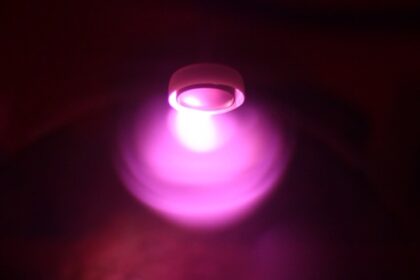
The current solution of Stomadent works on the principle that the energy needed to break the clusters (and obtain selected interactions between water molecules) is supplied to the system by means of remote resonant excitation, and the source of this resonant energy is a low-frequency low-temperature plasma generator, which generates the appropriate oscillation frequencies in the plasma. depending on the plasma current density. It is characteristic that even with prolonged exposure of water exposed to the plasma generator, it does not lead to a significant increase in temperature. However, during this process, when the distance to the plasma is less than 10 cm, it is clearly visible that a slight glow or glow appears in the treated water or aqueous solution.
Years of research work by Stomadent have led to finding optimal conditions for destroying large clusters or reducing their size, which allows to turn water into a liquid with improved homogeneity and repetitive declustered, or actually "microclustered" structure.
The functionality of the device developed by Stomadent
The water irradiation process carried out with the use of the Stomadent device is carried out with the participation of low-frequency, low-temperature plasma with appropriately selected parameters. Sometimes the low frequency is omitted in the name due to the simplification of the name and the fact that the plasma has a frequency appropriately matched to the water. The water during this process shows a slight glow, which is a fact both significant and unusual. The effect of such irradiation is to obtain declastization - breaking extensive hydrogen bonds, leaving only smaller size microcircuits, thanks to which some water properties change (eg: salt dissolving capacity, dielectric constant, etc ...).
The functionality of the device has been confirmed by the granting of patent protection (application number 389626, exclusive right number 216025), and was confirmed by the positive results of water sampled for analysis after the treatment process. There were also publications after the first patent application (e.g. xxi) and subsequent applications for patent protection. It is worth emphasizing that the resonant interactions of low-temperature plasma with matter, which at first glance are easy, though mistakenly classified as very weak, can, after appropriate selection of parameters, also affect metal alloys by modifying their parameters. For example, by plasma irradiation, it is possible to increase the mechanical strength of the alloys by 30% compared to the state before the treatment.
Properties of "declustered water"
In Stomadent, declasterized water is water treated in low-temperature plasma. Such water acquires appropriate chemical and physical properties defined by another name used for it: nanowater, i.e. water devoid of structures. However, the crowning physical parameter that is measured before and after treatment is the dielectric constant called relative permittivity, which in some cases varies more than 4 times. The refractive index corresponding to this parameter decreases after processing about twice, which seems amazing. In addition, there is an increase in the solubility of both solid and gaseous substances, changes in biological properties, etc.
Due to the patenting procedures, these new properties of water have not been widely presented to the public, nevertheless, both publications and further patent applications are being prepared (prior application numbers: 403613, 404997, 405267). The team of people working at Stomadent on the technology of nanowow treatment and application has several decades of experience in the country and abroad, e.g. numerous studies by Dr. Igor Elkin are known.
The research on the properties of water after the declasterization process in Stomadent devices was also carried out outside the Stomadent company. The research was verified in selected research centers from all over Poland, where the scientific reports in the form of reports stated:
- Stomadent - The control test of water before, during and after plasma treatment showed: a strong change in the electrical permittivity and ionic strength - pH, a noticeable change in color, density and refractive index, increased ability to form emulsions and suspensions. The fact that the permittivity measured against water before treatment is different, the ionic strength changes with the ionic product - this causes the concentration of H + and OH- ions to be different than 10-7. This is due to the nature of the dissociation constant (Kw) of water depending on the ionic strength (I), and therefore the solubility of both solids, gases and liquids increases.
- Chair and Department of Pharmaceutical Botany and Department of Clinical Genetics, Medical University of Lublin (Anna Och, MA, Marek Och, Dr. Anna Bogucka-Kocka, Dr. Janusz Kocki, viability and proliferation capacity of human hematopoietic neoplastic cells. Conclusions: In the culture of cells on the medium exposed to low-temperature plasma, a decrease in the density of the culture as a function of time was observed. These studies will be developed towards the application of treatment of leukemias and other cancers.
- Department of Histology and Embryology, Medical University of Bialystok, Department of Cell Biostructure. (Dr. Beata Szynaka, MD, PhD) Research on cells of the MOLT-4 cell line treated and untreated with declasterized water. One of the observations is the inhibition of cell division after treatment with declasterized water, and the effect of this water on cell apoptosis. The observation of fact is new and has not been described in the literature so far.
- Department of Experimental Pharmacology, Medical University of Bialystok (Dr. Halina Car, MD, PhD) Research on the U207 line, Conclusion: saline treated with plasma eliminates cells with damaged DNA, which allows the selection of cells containing uniform and normal DNA, and thus improving the function of tissues and organs.
- Department of Detailed Plant Cultivation at the University of Life Sciences in Lublin (Dr. Eng. Joanna Dziamba, Prof. Dr. hab. Szymon Dziamba) Research on the yield of beans and winter rye. Observation of the increase in yield by over 50% in relation to the control after using declustered water.
- Laboratory of Physicochemistry of Dielectrics and Magnetics, Faculty of Chemistry, University of Warsaw (Dr. Jadwiga Szydłowska, Prof. Dr. Wojciech Gadomski). No dangerous radicals were found in the nanowater.
- Wrocław University of Technology, Institute of Environmental Protection Engineering (Dr. Teodora M. Traczewska - Prof. Pwr, Dr. Magdalena Sitarska), Toxicity testing of tap water exposed to low-temperature plasma - tests using Ames 98/100 (mutagenicity test), Microtox ( genotoxicity / toxicity test), Algaltoxkit FTM (toxicity test), PhytotestkitTM (phytotoxicity test), RapidtoxkitTM (toxicity test) - conclusions no negative properties of nanowater, no toxicity.
- Wrocław University of Technology, Institute of Environmental Protection Engineering (Dr. Magdalena Sitarska). Assessment of the suitability of plasma-treated water in plant breeding - conclusion water after plasma treatment has a significant and positive effect on plant growth.
- University of Agriculture in Krakow, University of Life Sciences in Lublin (Dr. M. Murawski, Dr. T. Schwarz, J. Szymanowicz, Dr. K. Patkowski) - The use of supercritical water as a potential factor for the improvement of gamete conservation and storage results - application and patent application : the use of water after plasma treatment improves the viability of the stored semen by more than 30% compared to the existing solutions.
Summary
From the results presented above, and from the state of the literature, patent protection, it follows that the Stomadent device for low-temperature plasma treatment works as intended, giving water with specific biological properties, which is not toxic, does not contain free radicals, and has a positive effect on plant development, and their cells. Scientific research and product development offered by Stomadent have been appreciated by awarding numerous awards and distinctions in official competitions. Even if a theoretical model based on interpretations using concepts such as cluster, microcluster or nano-water were discussed or even questioned, it would never change the fact that the water passed through the Stomadent plasma device has properties quite different from the impermeable one. It is also a fact that the device works in a fully intended manner and the parameters of the product obtained are fully controllable, which makes it possible to obtain this product in an industrial manner with full quality control. The attempts to explain the observed phenomena by means of the formation of cluster structures and their destruction due to electromagnetic radiation still seem to be the best model supported by literature data and records of own research. Of course, the literature also includes examples of works on water clusters, in which the research was not carried out scrupulously, but these works are quickly negatively verified by others. these devices, for example, form clusters (sic). Simple water activators are also described on the basis of bottles, sticks, etc ... - these solutions seem to be purely marketing gimmicks and, of course, are not supported by any serious research. The works mentioned in this report were based on publications published in the so-called reputable journals (average IF above 15).
The solution presented by Stomadent is supported by years of quite painstaking work enriched by cooperation with research centers, publications, patents, knowledge derived from publications of the highest level, such as publications from the Science, ACS, Angewandte groups etc. The research and the conclusions drawn create a clear logical sequence that can be verified or repeated. Due to the application nature of research (patent preparation) and the innovation of research, the results have not been disclosed in such a wide manner as it was in this study.
Summary in points:
- water clusters exist, it has been proven experimentally and theoretically,
- the interaction between water molecules in the cluster and between the clusters affects the water properties, which also depend on the size of the clusters,
- the processes of dynamic formation and disintegration of clusters are also a fact - it results from the fact of the existence of clusters and their interactions with the forces of external fields,
- the operation of the Stomadent plasma device means that the water passed through the device has substantially and significantly different physical and biological properties,
- the mechanism of operation of the Stomadent device is based on the destruction of the structure of large water clusters, which leads to the formation of microclusters containing minimal amounts of particles,
- The properties of the treated water by the Stomadent device are different, both biological and physical, in relation to the untreated water. The changed properties are also observed during processing, e.g. afterglow and other anomalies.
Dr inż. Marek Doskocz
and
Przegląd Medyczny Uniwersytetu Rzeszowskiego i Narodowego Instytutu Leków w Warszawie Rzeszów 2011, 2, 254–258 –
http://fwww.pmurz.rzeszow.pl/PDF/2011/2/12_zeszyt2_2011.pdf
iiScience 2004;304: 995 DOI: 10.1126/science.1096205, Werner PH, Nordlund D, Bergmann U, Cavallieri M, Odelius M, Ogasawara H, Naslund LA, Hirsch TK, Ojamae L, Glatzel P, Petterssen LGM, Nilsson A. The structure of the first coordination shell in liquid water, http://www.sciencemag.org/content/304/5673/995.full
iii Chemical Physics Letters 2008;460:387. Tokushima T, Harada Y, Takahashi O, Senda Y, Ohashi H, Petterssen LM, Nilsson A, Shin S. High resolution X-ray emision spectroscopy of liquid water: the observation of two structural motif.
http://www.sciencedirect.com/science/article/pii/S0009261408005745
iv Science 309 (5731): 78–102. July 2005 „So much more to know”
vChemical Physics Letters , Volume 484, Issues 4–6, 7 January 2010, 144–147 , Theoretical study on icosahedral water clusters , Oleksandr Loboda, Vladyslav Goncharuk http://www.sciencedirect.com/science/article/pii/S0009261409014493
vi Angew. Chem. Int. Ed., 40: 1808–1827. doi: 10.1002/1521-3773(20010518)40:10<1808::AID-ANIE1808>3.0.CO;2-1,Ludwig, R. (2001), Water: From Clusters to the Bulk. http://onlinelibrary.wiley.com/doi/10.1002/1521-3773%2820010518%2940:10%3C1808::AID-ANIE1808%3E3.0.CO;2-1/abstract
viiScience 27 September 1996: Vol. 273 no. 5283 pp. 1843-1848, DOI: 10.1126/science.273.5283.1843. Peculiarities of Methane Clathrate Hydrate Formation and Solid-State Deformation, Including Possible Superheating of Water Ice, Laura A. Stern, Stephen H. Kirby, William B. Durham, http://www.sciencemag.org/content/273/5283/1843.abstract?sid=5982abf9-9184-4852-bd31-081d03c96a0d
viiiPrace teoretyczne łatwo znaleźć w PubMedzie wpisując „water cluster” http://www.ncbi.nlm.nih.gov/pubmed/?term=water+cluster, ze względu na ich liczbę nie będą tutaj wszystkie wyminione, niektóre z nich zostały już uwzględnione w tym spisie literaturowym, inne np.:
Theoretical study on icosahedral water clusters Chemical Physics Letters, Volume 484, Issues 4–6, 7 January 2010, Pages 144-147, Oleksandr Loboda, Vladyslav Goncharuk Electrical field effects on dipole moment, structure and energetic of (H2O)n (2 ⩽ n ⩽ 15) cluster
Journal of Molecular Structure: THEOCHEM, Volume 915, Issues 1–3, 15 December 2009, Pages 170-177 Evelyn J.L. Toledo, Rogério Custodio, Teodorico C. Ramalho, Maria Eugênia Garcia Porto, Zuy M. Magriotis
ixNature Chemistry, 5, 29–35, (2013) doi:10.1038/nchem.1503 A ‘clusters-in-liquid’ method for calculating infrared spectra identifies the proton-transfer mode in acidic aqueous solutions Waldemar Kulig, Noam Agmon, http://www.nature.com/nchem/journal/v5/n1/full/nchem.1503.html
x Angewandte Chemie International Edition Volume 49, Issue 52, pages 10119–10122, December 27, 2010 Infrared Spectra and Hydrogen-Bonded Network Structures of Large Protonated Water Clusters H+(H2O)n (n=20–200) Kenta Mizuse, Naohiko Mikami, Asuka Fujii, http://onlinelibrary.wiley.com/doi/10.1002/anie.201003662/abstract
xiPhysical Sciences – Chemistry: Teresa Head-Gordon and Margaret E. Johnson, Tetrahedral structure or chains for liquid water PNAS 2006 103 (21) 7973-7977; published ahead of print May 12, 2006, doi:10.1073/pnas.0510593103
http://www.pnas.org/citmgr?gca=pnas;103/21/7973
xiiHigh resolution X-ray emission spectroscopy of water and its assignment based on two structural motifs Takashi Tokushimaa, Yoshihisa Haradaa, b, Yuka Horikawa, Osamu Takahashi, Yasunori Senba, Haruhiko Ohashi,Lars G.M. Pettersson, Anders Nilsson, Shik Shin, Journal of Electron Spectroscopy and Related Phenomena, Volume 177, Issues 2–3, March 2010, Pages 192–205
http://www.sciencedirect.com/science/article/pii/S0368204810000198
xiiiElectronic structure effects in liquid water studied by photoelectron spectroscopy and density functional theoryChemical Physics Letters, D. Nordlund, M. Odelius, H. Bluhm, H. Ogasawara, L.G.M. Pettersson, A. Nilsson Volume 460, Issues 1–3, 20 July 2008, Pages 86–92, http://www.sciencedirect.com/science/article/pii/S0009261408005897
xivVacuum Ultraviolet (VUV) Photoionization of Small Water Clusters, Leonid Belau , Kevin R. Wilson , Stephen R. Leone , Musahid Ahmed, J. Phys. Chem. A, 2007, 111 (40), pp 10075–10083,
http://pubs.acs.org/doi/abs/10.1021/jp075263v
xvFemtosecond photoionization of (H2O)n and (D2O)n clusters Radi, P. P.; Beaud, P.; Franzke, D.; Frey, H.-M.; Gerber, T.; Mischler, B.; Tzannis, A.-P. Journal of Chemical Physics, Volume 111, Issue 2, pp. 512-518 (1999).
http://scitation.aip.org/content/aip/journal/jcp/111/2/10.1063/1.479330
xviFormation and decomposition of water clusters as observed in a triple quadrupole mass spectrometer, Simone Königa, Henry M Falesa, Journal of the American Society for Mass Spectrometry Volume 9, Issue 8, August 1998, Pages 814–822,
http://www.sciencedirect.com/science/article/pii/S1044030598000440
xviiThe European Physical Journal D – Atomic, Molecular, Optical and Plasma Physics October 2001, Volume 16, Issue 1, pp 95-97 Solvation and chemical reaction of sodium in water clusters, C. Bobbert, C.P. Schulz
http://link.springer.com/article/10.1007%2Fs100530170068
xviii Kinetics and Mechanism of Water Cluster Equilibria, F. Weinhold, J. Phys. Chem. B, Article ASAP, DOI: 10.1021/jp411475s Publication Date (Web): January 17, 2014,
http://pubs.acs.org/doi/abs/10.1021/jp411475s
xixDielectric Studies of Water Clusters in Cyclodextrins: Relevance to the Transition between Slow and Fast Forms of Thrombin, Stephen Bone, J. Phys. Chem. B, 2006, 110 (41), pp 20609–20614 DOI:10.1021/jp063811j,
http://pubs.acs.org/doi/abs/10.1021/jp063811j
xx Small-molecule Binding to the DNA Minor Groove Is Mediated by a Conserved Water Cluster, J. Am. Chem. Soc., 2013, 135 (4), pp 1369–1377 ,
http://pubs.acs.org/doi/abs/10.1021/ja308952y
xxiJ Nanopart Res (2014) 16:2176, DOI 10.1007/s11051-013-2176-2, Non-thermal plasma-driven synthesis of Eu3+:Y2O3 nanosized phosphors Piotr Psuja Wieslaw Strek Ihar Yelkin
http://link.springer.com/article/10.1007/s11051-013-2176-2
xxii Phys Lett A 377 , 2013, 2826-2827 Comment on: “Evidence for the existence of stable-water-clusters at room temperature and normal pressure” [Phys. Lett. A 373 (2009) 3872], http://www.deepdyve.com/lp/elsevier/comment-on-evidence-for-the-existence-of-stablewater-clusters-at-room-6u3lYxiFtz